MEDIA RESEARCH? definition

Media Psychology is a new and emerging field, so the early entrants have the excitement and burden of defining the path.
What is media psychology? It’s a field with no consensus definition, no clearly-defined career paths, and no easy answers. In spite of that, it can add value anywhere human behavior intersects media technologies. Here’s why:
- Media technologies are everywhere
- People of all ages use media technologies a lot
- Young people use them most
- Older people worry about younger people
- Technology is not going away
- We all worry if this is good or bad or somewhere in-between
- Psychology is the study of people of all ages
 Media psychology is using #7 to answer #6 because of #1 through #5
Psychology is key to understanding the implications of technology. Consequently, it seems like it should be pretty straightforward to define media psychology. For some reason, though, it’s not. I have had discussions with colleagues for hours (or at least it seems like it) about what constitutes media, mediated communication, and technology and what we mean by psychology in the context of media—and we’re not even philosophers. In this and the following two posts, I will discuss my definition of media psychology and why I think media psychology is so important.
Both media and psychology have made major contributions to western culture throughout the 20th century. ? The term “media, ” however, used to be confinable to a bucket labeled “mass media.” Our awareness of media, however, has reached the collective consciousness, as if we all woke up yesterday, awakened by our programmable alarm with the iPod attachment, and over our coffee made automatically by our coffeemaker, checked our blackberry for emails and headline news and then looked up shocked to see that our kids are doing much the same. This awareness is leaving people clamoring for a new level of understanding. There is an infiltration of media applications and information technologies into nearly every aspect of our lives. What does it all MEAN? Just like Mighty Mouse (or maybe Underdog), media psychology emerged in a time of need.
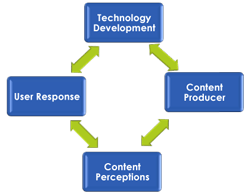
The goal of media psychologists is to try to answer those questions by combining an understanding of human behavior, cognition, and emotions with an equal understanding of media technologies. Unlike some types of media studies, media psychology is not just concerned with content. Media psychology looks at the whole system. There is no beginning and no end. It is a continual loop including the technology developer, content producer, content perceptions, and user response. Just as Bandera describes social cognitive theory as the reciprocal action between environment, behavior, and cognition, so does media psychology evaluate the interactive process of the system. There is no chicken, no egg to this system. They all coexist and coevolve with each other.
You might also like